
Food Lists and Pesticide Exposure
Observational studies of organic food suggest that one of its potential health benefits is reduced exposure to pesticide residues.
Learn more:
Does organic food really matter for health
In this context, an important role is played by non-governmental organisations that analyse official monitoring data and translate them into more accessible information tools.
Organic Food and Pesticide Residues: What the EWG and UK Lists Show
In the United States, this role is fulfilled by the Environmental Working Group (EWG).
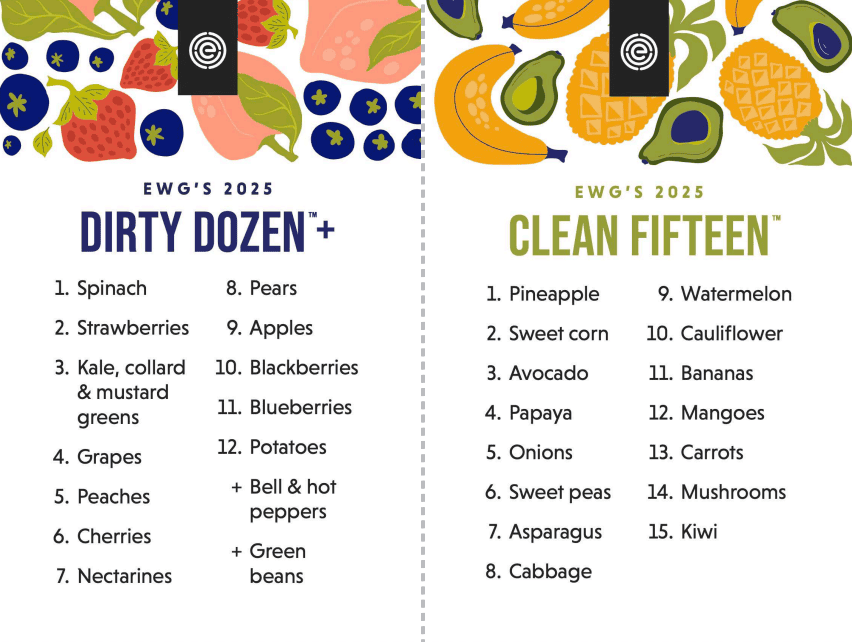
EWG publishes two annual lists: Dirty Dozen™ (the most pesticide-contaminated vegetables and fruits) and Clean Fifteen™ (the lowest amounts of pesticide residues).
Based on official data from U.S. regulatory agencies, these lists identify conventionally grown fruits and vegetables that most often contain multiple pesticide residues, as well as those that tend to show relatively low residue levels. The EWG lists do not assess nutritional quality; their purpose is to help reduce chemical exposure, particularly when choosing organic food selectively.
The 2025 Dirty Dozen™ and The Clean Fifteen™
Learn more:
Dirty Dozen™
Clean Fifteen™
The EWG lists are also frequently cited in European popular science publications – as an illustrative tool showing relative differences in pesticide exposure.
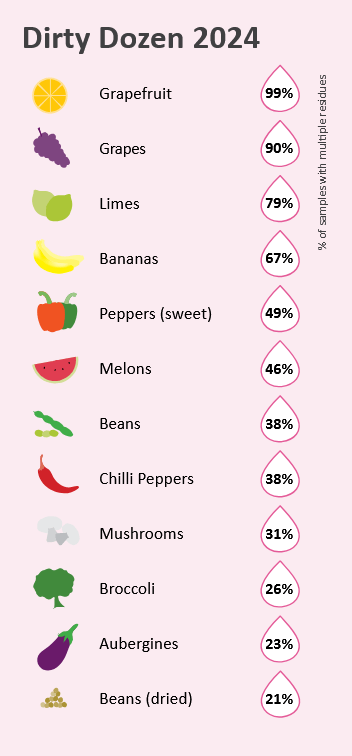
The 2025 Dirty Dozen – UK
In the UK, a similar analysis is being carried out by Pesticide Action Network UK (PAN UK).
Using government monitoring data from Pesticide Residues in Food (PRiF) andHealth and Safety Executive (HSE), PAN UK publishes its own Dirty Dozen list, highlighting products in which multiple pesticide residues are most frequently detected. Unlike EWG, PAN UK does not publish a “Clean Fifteen” equivalent, stating that UK monitoring data do not support the reliable identification of products with consistently low exposure.
The list is based on results from 2024 – the most recent year for which data is available.
PAN UK also analysed the UK government’s testing results for bread:
Chlormequat – a plant growth regulator classified as a developmental toxin – was found in 97% of samples.
Glyphosate – the UK’s most widely used herbicide linked repeatedly to various cancers and other chronic diseases – appeared in more than a quarter (28%) of bread samples.
Almost half (47%) of the 216 samples of bread tested by the government contained
“pesticide cocktails“.
“Safety limits are set for one pesticide at a time, completely ignoring the fact that it’s all too common for food to contain multiple chemicals. The truth is we know very little about how these chemicals interact with each other, or what this exposure to hundreds of different pesticides is doing to our health in the long-term. What we do know is that pesticides can become more toxic when combined, a phenomenon known as ‘the cocktail effect’.” – PAN UK
Both the EWG lists and the PAN UK analysis provide a practical complement to organic food research, helping to identify differences between conventional and organic production. This is particularly important for reducing pesticide exposure.
SOURCES:
Pesticide Residues in Food (PRiF)
Strona zespołu eksperckiego wraz z linkami do rocznych i kwartalnych raportów dotyczących pozostałości pestycydów w żywności.
Health and Safety Executive (HSE)
Sekcja poświęcona pestycydom, obejmująca regulacje, nadzór oraz publikacje, na których opierają się m.in. analizy PRiF i NGO (np. PAN UK).
Environmental Working Group (EWG)
Pesticide Action Network UK (PAN UK)
PICTURES:
Unsplash
Pexels
EWG
PAN UK

 my59
my59 
Leave a comment